The semantic model finally has its moment
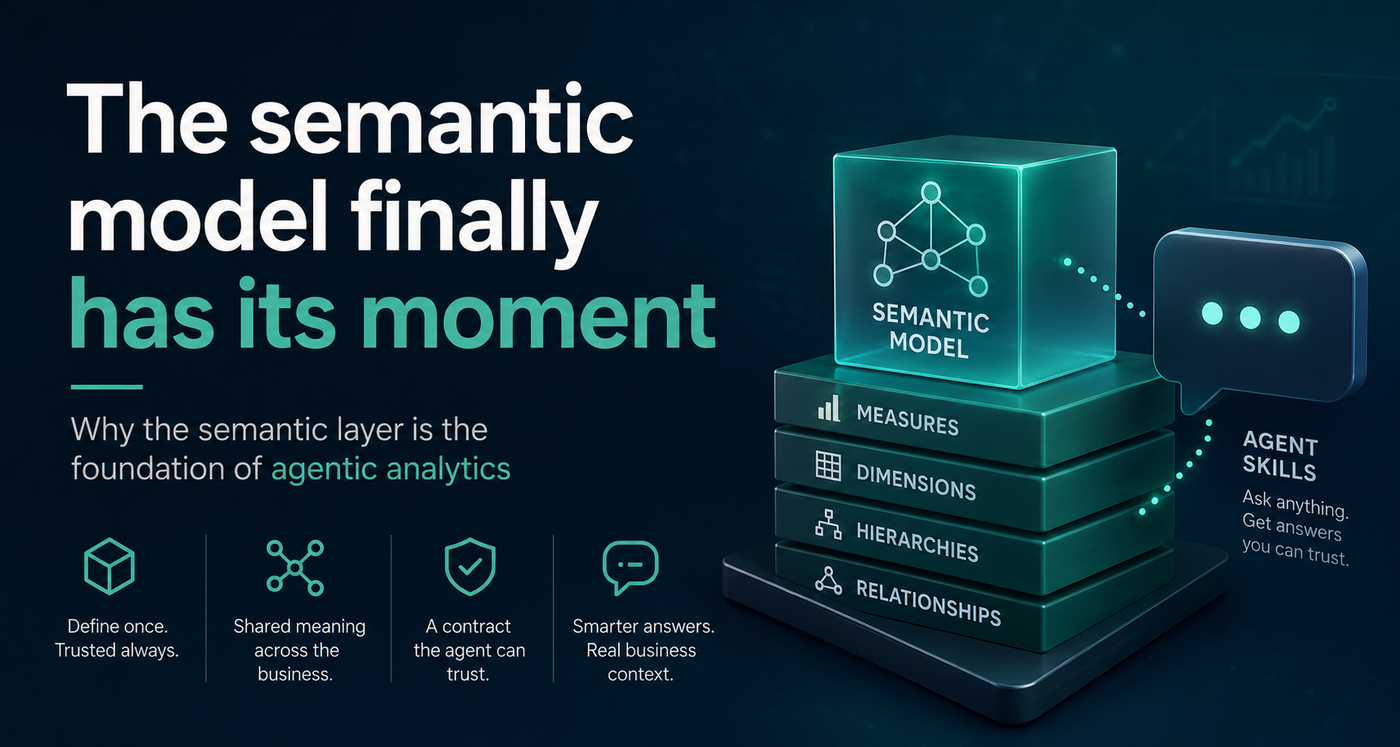
Eighteen months ago I presented a talk called "Why a Semantic Model is the LLM's Best Data Source." It wasn't a contentious position in the room I gave it in (the room was a community of Power BI developers who already had skin in the game), but it was contentious outside the room. The dominant noise at the time was vector embeddings, RAG architectures, and the idea that you could point a language model at a heap of documents and pull useful answers out the other end.
I always thought that was the wrong end of the problem.
This week Microsoft used the closing keynote for Build 2026 to put a name on the direction for Power BI: "the agentic era of analytics." Semantic layer plus agent skills as the strategic shape.
What the keynote actually said
Strip out the marketing and the message is straightforward. Build a semantic model that defines your measures, your dimensions, your hierarchies. Expose that model to an agent. Let the agent answer questions against it.
The semantic model is the contract. It says "this is what 'sales' means in this business, this is what 'gross margin' means, this is what 'late shipment' means." Without that contract, the model has to guess — and a language model guessing on top of raw fact tables is exactly how you end up with the demo that worked on Tuesday and embarrassed everyone on Wednesday.
With it, the model has somewhere stable to stand. It can compose questions, traverse relationships, and apply filters in the way the business actually intends them.
The bit the marketing doesn't say
The semantic model only works if you've already done the underlying work.
That means a fact table that is actually a fact table, joined to dimensions that are actually dimensions, with measures that have been argued about, named, and signed off by the people who will use them. It means time-intelligence that behaves the way the controllers expect. It means a definition of "active customer" that finance and sales both agree on.
I have spent years of my career on this work. So has every BI practitioner I respect. None of it is glamorous. It rarely features in conference demos. It is, however, the load-bearing wall.
A semantic model is not a thing you generate. It is a thing you negotiate. You sit across the table from the people who own the data and you argue about what it actually means, and you write the definitions down, and the next time someone asks, you have a referee instead of an opinion.
The agent inherits that referee. That is what makes the agent useful.
What this looks like in practice
When I built a semantic model for a production-shop-floor lakehouse earlier this year, the work that mattered wasn't the DAX. The DAX took an afternoon. The work that mattered was the three days I spent in the plant arguing about what OEE actually included on the third shift, what counted as planned downtime versus unplanned, and whether tool changes belonged in the productivity numerator or the denominator.
Once that was settled, the model wrote itself. Once the model existed, the report wrote itself. And the day I plug an agent into that semantic model (which I haven't yet done in production, but the architecture is two short pieces of plumbing away) the agent will inherit all of that arguing for free.
That is the bet Microsoft is making. It is the right bet.
The risk for everybody else
The risk is that "agentic analytics" gets sold as a shortcut around the unglamorous work, and a generation of buyers tries to skip straight from spreadsheet to agent without ever doing the modelling in between.
It will not work. The same way RAG didn't work for the people who pointed it at unstructured shared drives and hoped for the best. The same way "let the LLM read the warehouse directly" doesn't work for anyone who has tried it past the demo.
There is no shortcut around defining your business. The semantic model is where you define your business. If you've already done that work, the agent is a thrilling new front end. If you haven't, the agent is a confident-sounding stranger answering questions you haven't yet decided.
I am pleased the keynote acknowledged the architecture. I will be more pleased when the implementation guides catch up.