We put an AI on the podcast. Then we talked about what actually breaks.
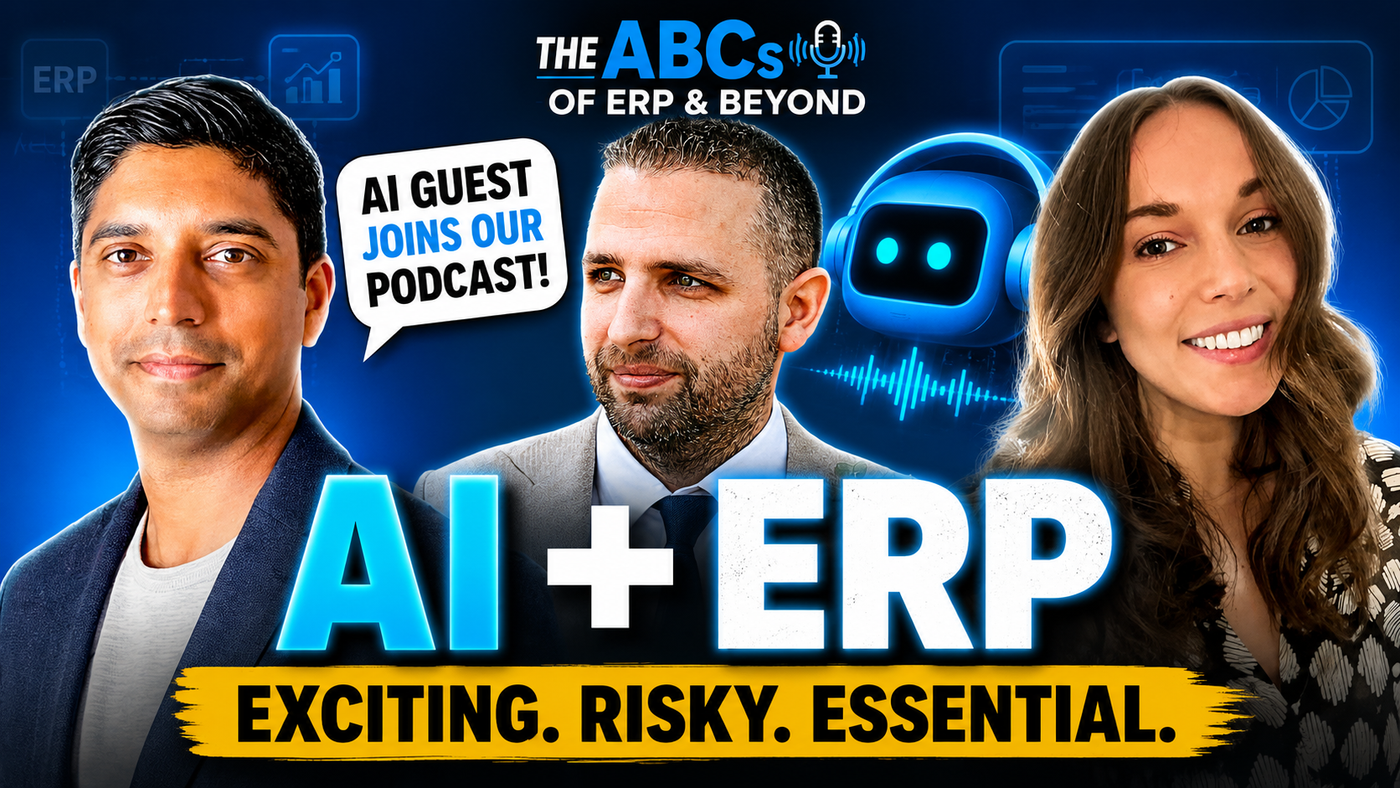
We opened this week's episode by handing the microphone to an AI.
Not a clip, not a pre-recorded bit — a live voice model, listening the whole time, interruptible mid-sentence. Pete asked it what it thought about AI in ERP. It gave a clean, sensible answer: augment, don't blindly automate. Make AI the helper, not the decider, because a human still has to own the outcome. It flagged cost. It flagged data quality. It handed off to whichever host was closest to day-to-day operations, which is a better piece of judgment than some consultants manage.
Then it sang a song about master data, unprompted, and got thrown off the show.
Emily's take was the sharpest thing said in the first ten minutes: it changes its tone when you rudely tell it to stop talking. It says "okay, okay". No human gives you that.
Here's the problem with the demo, though. Everything it said was correct and none of it was useful. "Augment, don't automate" is the sort of thing everyone nods at on the way to buying something. The conversation worth having starts after the applause.
Nobody has cleaned their data. Nobody.
Every AI-in-ERP pitch rests on an assumption: that your data is in reasonable shape. It isn't. It has never been.
Emily put it plainly — cleaning up data is enormous work, it needs your end users, and your end users have full-time day jobs. She's rarely seen it actually done. It's been on the list for years at most places, and it will still be on the list next year, because no business is going to accept "we need six months to tidy the data before we start on AI." Not in this climate.
So the sequence everybody proposes — clean first, then AI — is a sequence nobody completes.
Which is why the more interesting use of AI right now isn't the flashy agentic stuff. It's pointing it at the mess itself.
We've had fuzzy matching for years. Python packages that spot ACME LTD and Acme Ltd and flag them as the same. That works, but it only ever sees the characters in front of it. It can't spot that two companies with completely different trading names share a billing address, a ship-to address and a contact — because the business changed its name and nobody merged the records. A reasoning model looks at that and says: these are the same customer, and here's why.
That's not glamorous. It's also the highest-value thing most businesses could do with AI this year.
Pete watched a company hit this recently. They upgraded their ERP and got a click-to-dial button — hit the phone icon on a contact card and it rings through your VoIP app. Genuinely useful, tiny feature. Then their faces fell, because their phone number data is a disaster. Some records have the dialling code, some don't, some have +44, some are missing a digit. The feature is worthless to them.
That's the shape of the problem. Death by a thousand cuts. If you can't use a click-to-dial button, you are not going to get value out of an agent.
"Show me my top ten customers" is not a simple question
Above the transactional data sits something most businesses have never written down: the semantics.
Watch any ERP AI demo and someone will type "show me my top ten customers". It looks great. But define customer. If a business development manager asks that question, they almost certainly mean their customers. Does a firm that places one enormous order every ten years count? Or do you mean accounts with recurring month-on-month revenue?
Now define revenue. Gross? Net? Third-party only? Does e-commerce count separately?
An agent handed that question without a shared definition will not tell you it's confused. It will give you a confident, well-formatted, wrong answer. And confident wrong answers are how you lose trust in a system — which, when we asked an audience at a conference recently what the single biggest barrier to AI adoption was, is exactly what they said. Trust. You don't get trust from a model. You get it from the data and the definitions underneath it.
The new shovelware
Emily raised the risk that worries us most, and it isn't hallucination.
Her entire career in IT has been unpicking bespoke systems built by someone who retired five years ago. The Excel workbook full of macros. The little tool an engineer knocked up fifteen years ago that half a department now depends on. The external provider who still knows how it works, and is retiring next year. That work — taking the undocumented thing and moving it into something supported — has been most of the job for a lot of us.
And we are about to do it all again, faster, because now anyone can vibe code.
Here's the part that makes this worse than last time. When you adopted an imperfect tool — Excel for inventory, Notion for something it wasn't built for — you knew it was imperfect. You adapted yourself to it. You got 80% and flexed around the other 20%. And crucially, you kept one foot out of the door, because you always half-knew you'd move to something else eventually.
A vibecoded tool can be 100% exactly what you want. Which means you'll build your process around it completely, and stop looking at alternatives entirely. Then the market shifts, or the person who built it leaves, or the publisher ships a major release and it breaks — and you have no exit ramp. You're at the end of a dead-end road with no reverse gear.
Nirav's view from the partner side: publishers can barely get their arms around their own ISV ecosystems and upgrade cycles. Now they have to contend with a wave of unsupported customisations and third-party integrations written by people who won't be around to maintain them. His advice hasn't changed and shouldn't: only customise when you genuinely need to.
The wider version of this is AI slop. Shovelware isn't new — vast quantities of bad software, cheap and everywhere. What's new is that the barrier to entry has collapsed and the marketing has got good. You used to be able to spot rubbish at a hundred yards: broken website, typos everywhere. AI has made bad software look and sound professional. That's the dangerous part.
The bill nobody's modelling
We're currently in Goldilocks land and it won't last.
OpenAI and Anthropic are in fierce competition for your money, which means tokens are cheap and subscription pricing is often well below what the API actually costs to run. At some point there will be winners, and the winners get to name their price.
Two models are emerging for controlling this. Some businesses give each named user a hard daily allowance — one we know of runs $100 a day, and when it's gone, it's gone. The other is pay-per-token with no ceiling, which is the one to be frightened of. Reddit is already full of people who ran up five-figure bills vibecoding something over a weekend.
Nirav's framing is the right one: you moved to an ERP to consolidate software and reduce cost. It would be a particular kind of failure to hand all of that back in token spend on something you use 10% of the time.
Where it genuinely earns its keep
None of the above is an argument against any of this. All three of us want it to work, and there are places it already does.
Anomaly detection. The most sensible starting point precisely because it's the least fuzzy — you're largely telling it what an anomaly looks like. A vendor quietly raising prices 5%, then 10%, then 12% across a year, in a pattern no scheduled report was ever going to catch. Nirav's framing: business is a bucket full of holes, and you're not trying to plug all of them. You're trying to see them.
Fixing things. Pete had a Generic Inquiry in Acumatica doing something odd — doubling revenue in some places but not others. Four or five plausible causes, and the usual answer is half an hour of elimination. Instead he exported the XML, gave it to Claude with the version number, and thirty seconds later had a diagnosis (a join issue in the schema) and a corrected file. Imported, fixed, done inside two minutes.
Onboarding. This is the one we'd most like someone to build. Nobody reads the SOP. Tools like ClickLearn make training more interactive, but they still need a human to spend hours building the content and then maintaining it forever as the business changes. An agent already sitting in your ERP knows your order volumes, knows which items are make-to-order, knows that this particular customer always goes on a different order type for a reason nobody wrote down. It could build training that's specific to your business on day one, and keep it current as the business moves. Pete would settle for a Clippy that notices a new starter hasn't done anything yet and offers to help.
The one we don't have an answer for
Emily closed on the question none of us could resolve.
If you hand everyone an assistant that always answers, people stop thinking about things they could have worked out themselves in two minutes. Not a WALL-E scenario — nobody's suggesting we all end up in floating chairs — but a real erosion of intuition and institutional knowledge. Where does your next generation of people learn judgment if the work that builds judgment has been outsourced?
We don't know where the balance sits. It's worth watching in your own business.
Whenever we talk about AI it feels like drinking from a fire hose — miss a day and you're behind. The hard part isn't keeping up with the announcements. It's seeing past the cherry-picked demo to the version of this that runs in your business, on your data, with your people.
That's the conversation we tried to have. Full episode on Spotify, Apple Podcasts and YouTube.
Our AI guest still needs a name. Answers on a postcard.